
Roundup or No?
What we spray says a lot about what we believe.

ROUNDUP. Can we start talking about this word itself?
Round up.
As in …
gather them up
sweep it all together
control the field
eradicate what doesn’t belong
The word “roundup” originally comes from livestock culture in the American West. It referred to the gathering and corralling of scattered cattle across open land … literally “rounding up” animals for control, sorting, branding, or removal. Over time, the term became associated with containment, elimination, and clearing what was considered unwanted. Which makes it a strangely revealing name for a chemical designed to wipe out living systems we’ve decided no longer belong.
It sounds way less like gardening or growth and more like an evil military operation to me … how about to you?
Roundup is the trade name for a glyphosate-based herbicide originally developed by Monsanto and now owned by Bayer. It was designed to kill weeds by disrupting a plant enzyme pathway essential for growth. Today, it’s one of the most widely used weedkillers in the world and its disturbing presence extends far beyond the weeds it was created to eliminate.
How is it possible that we have normalized spraying this stuff on food crops, suburban lawns, schoolyards, parks, and National Forests? (that’s written in the tone of me screaming)
I mean, forests!! Entire ecosystems are being chemically “managed” because we’ve become so uncomfortable with disorder, diversity, weeds, insects, wildness, unpredictability … nature itself.
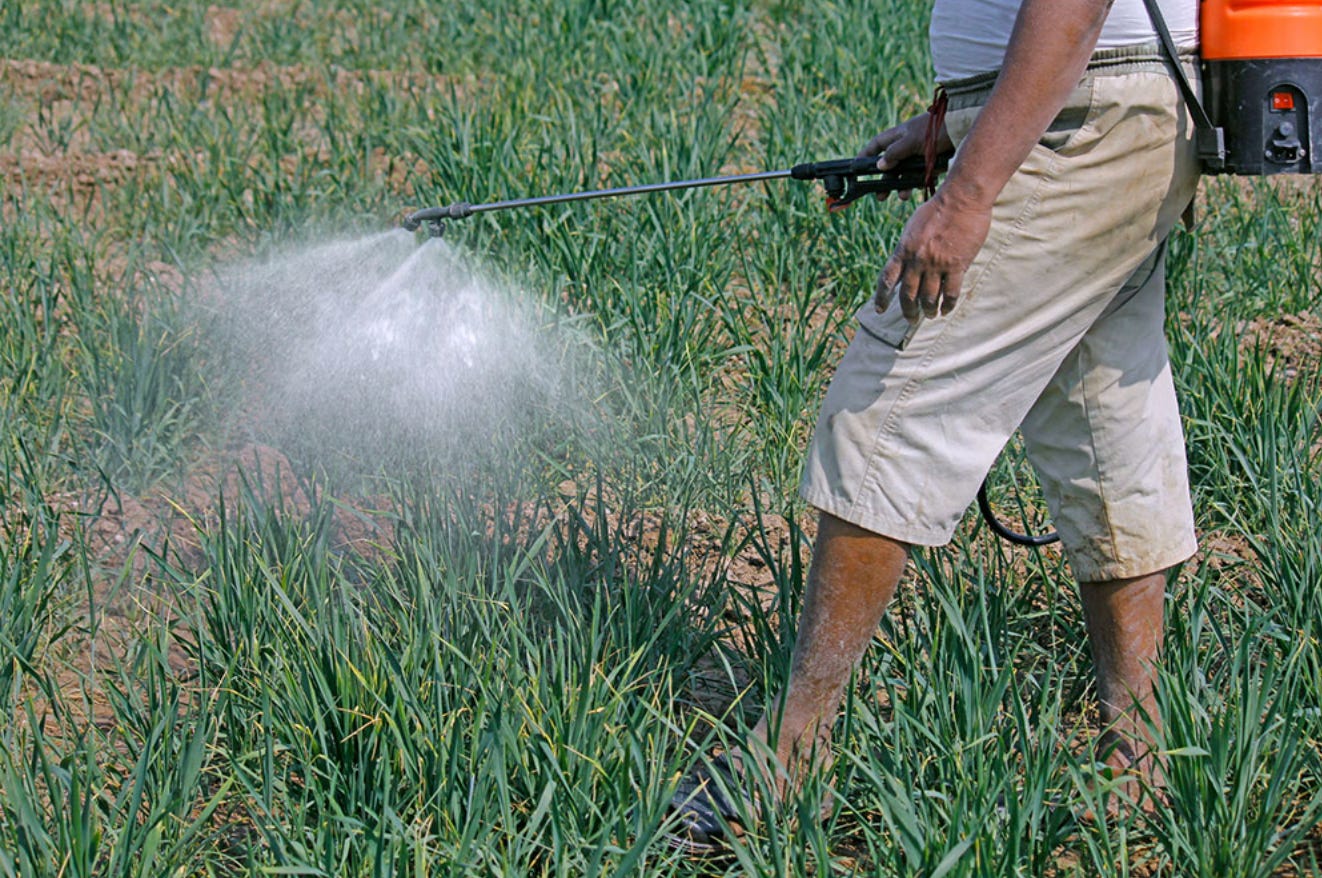
Eighteen different pesticide compounds were detected in public parks and playgrounds at 10 sites across Illinois last summer, including some agrichemicals that drifted at least 3,700 feet from the nearest spray site. (source)
“It doesn’t really matter how far you are from an agricultural field, a golf course, or other site of large-scale application, these pesticides are not staying put.” ~ Kim Erndt-Pitcher, director of ecological health at the Prairie Rivers Network
^ image credit: gailher law
When did we decide that living things that inconvenience us deserve extermination?
What fascinates me (in a truly horrified and baffled way) is how disconnected we’ve become from cause and effect. Why are dandelions on lawns treated like the enemy? How are so many in favour of exterminating weeds in the fields where our food is grown? I mean, it’s pretty clear that the spray hits our food and kills our soil, air and water too.
We spray poison to kill life and then wonder why soil is depleted, why pollinators disappear, why waterways are contaminated, why chronic illness is skyrocketing, why our kids can’t tolerate foods anymore, why our dogs are rolling around on chemically treated grass and getting sick, and why our bodies seem overloaded, inflamed, exhausted, disregulated. This isn’t fringe anymore … this is basic pattern recognition.
The creepiest part may be how casual it all became.
Commercials (and our neighbours) made it look clean, convenient and even responsible.
Is the highest form of human intelligence really eliminating dandelions? Meanwhile, the dandelion has medicinal properties, feeds pollinators, breaks up compacted soil, and survives almost anything.
Maybe the weed isn’t the problem … maybe our obsession with control is.
“Roundup or no?” That’s the question.
Before you answer, pause … this isn’t only about a product but about a worldview.
Do we choose to continue waging war against living systems in the name of aesthetics, efficiency, and profit? Or do we finally admit that poisoning the environment we live in might not be the brilliant long-term strategy we were sold?
Because this is not abstract anymore.
It’s in our soil, our rain, our food, our rivers and forests and in our bloodstreams … and THAT should concern everyone.
So what do we do?
Perhaps we can stop waiting for giant systems to suddenly grow a conscience and we create our own better ones.
It might not be perfect or all at once and it’s not going to happen through fear and doom spirals or screaming at strangers on the internet.
We can all start where we are right now and learn to ask better questions, support farmers who care about soil, and stop spraying our lawns because someone convinced us clover is a crisis.
We can grow herbs on balconies, buy less toxic products, consume with Empathy Economics, teach kids what food actually is, reconnect to ecosystems instead of declaring war on them, and maybe, most importantly, stop outsourcing all responsibility while pretending we’re powerless.
Because … WE ARE NOT powerless!
I can prove this. Seriously. I watch people change their lives through small consistent shifts every single day. I also have been fortunate to have conversations with remarkable humans on missions and making change, who empower me.
A nervous system calms, a garden grows, a community forms. a local farmer survives, a child learns. a patch of soil comes back to life, a person starts paying attention again and smiles.
This all makes a difference.
We definitely don’t control the entire machine, but we absolutely influence the reality directly around us. That’s how every meaningful shift in history has started … with one, with us.
Again, it won’t be perfect and no one in perceived power is going to give us permission. But, us humans thinking, “Maybe this way isn’t working anymore” could change everything.
In a world full of noise, chemicals, marketing, convenience, and normalized disconnect … choosing consciousness is a rebellious act.
It’s our choice. It’s not about becoming paranoid or obsessive but about becoming intelligent again. In our own power … and living like human and environmental health are not separate (they never have been).
Roundup or no?
I know my answer. What’s yours?
Imagine what might happen if you decide to invest in calming your nervous system, grow something green, become part of community, help a local farmer survive and thrive, teach a child about better, bring a patch of soil back to life, or help someone you care about to see things differently.
We can win.
We can choose regeneration over Roundup.
We can restore life instead of eliminating it.
That’s what we show up for daily in The Wellness Intelligence Collective and you have an open invitation … if you’re ready to question more, notice more, and participate in creating something better.
Here’s to better.
LB 💛
Great share, Lisa. Ugh. So sad to see all the anti glyphosate campaign work we did 20 years ago fell on deaf ears. I think there is a Native American quote about that- once there is awareness and more $ it will be too late. Sadly, now it has taken over agriculture (hate that word) so bad they are talking of subsidizing farms who use it, saying our food system depends on it. 🤯💔
I had a similar experience with someone who's home inwas staying at. The gardner came and sprayed roundup on her driveway and lawn. When I questioned her she said " how else can I kill the weeds?"